2026 Best Solar Monitoring System for Global Buyers?
The global push for sustainable energy has made solar monitoring systems increasingly vital. According to the International Renewable Energy Agency (IRENA), solar energy could account for over 30% of the global power mix by 2030. This growth highlights the importance of optimizing solar performance through advanced monitoring technologies.
Experts like Dr. Angela Wright, a prominent solar technology analyst, emphasize that “effective monitoring is the backbone of any successful solar deployment.” As purchasers look for the best solar monitoring systems in 2026, they must consider key features, reliability, and user-friendliness.
The landscape of solar technology is evolving rapidly. Many systems still struggle with interoperability and data accuracy. Addressing these challenges is crucial for enhancing system efficiency. As the industry grows, the demand for reliable solar monitoring solutions will only increase, pushing developers to innovate continually.
Overview of Solar Monitoring Systems: Importance and Benefits
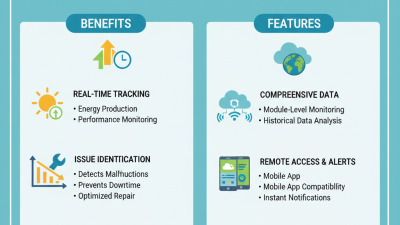
Solar monitoring systems play a crucial role in optimizing renewable energy use. They provide real-time data on system performance, energy production, and usage patterns. Access to this data helps users identify inefficiencies quickly. This insight can lead to significant cost savings over time. System owners can adjust their energy strategies based on accurate and timely information.
The main benefits of these systems include enhanced energy efficiency and improved maintenance. Users can monitor output and spot issues before they escalate. Many systems also offer remote access, allowing users to check performance from anywhere. This flexibility increases user engagement and promotes prompt responses to any concerns. However, there can be a learning curve for new users. Understanding the complexities of recorded data can be challenging.
Investing in an effective solar monitoring system is not solely about technology. It demands ongoing user interaction and awareness. Data can sometimes be overwhelming, which may lead to confusion. Users should regularly review their insights and challenge their interpretations. Effective use of these systems ultimately depends on the user’s commitment to continuous learning and adaptation.
2026 Best Solar Monitoring System for Global Buyers
| System Feature |
Description |
Benefits |
User Rating (out of 5) |
| Real-time Monitoring |
Track solar panel performance and energy production in real-time |
Immediate insights for better energy management |
4.8 |
| Mobile App Access |
Access data via smartphone applications |
Convenient monitoring on-the-go |
4.6 |
| Alerts and Notifications |
Receive updates on system performance |
Proactive measures for system maintenance |
4.7 |
| Energy Usage Reports |
Detailed insights on energy consumption |
Identifying savings and efficiency improvement opportunities |
4.5 |
| Integration with Home Automation |
Seamless connection with smart home devices |
Enhanced energy management through smart technology |
4.9 |
Key Features to Look for in Solar Monitoring Systems for 2026
When choosing a solar monitoring system in 2026, consider several key features. Effective real-time data tracking is crucial. Systems should offer accurate insights into energy production and consumption. This helps users make informed decisions about usage patterns.
User-friendly interfaces are equally important. A well-designed dashboard can simplify data interpretation. Look for mobile app compatibility. This allows easy access to performance statistics on the go. Alerts and notifications also enhance user experience. They inform homeowners of system performance issues.
Data security is another vital aspect. Systems must protect user information against breaches. Transparency about data handling builds trust. Ensure that the monitoring system you choose complies with relevant data protection regulations. Regular software updates are essential for maintaining security and functionality. Remember to read user reviews. They can offer insights into real-world experiences and highlight common problems or benefits.
2026 Best Solar Monitoring System Comparison
This chart displays a comparison of key features for top solar monitoring systems in 2026, including efficiency, cost, user ratings, and the number of features available. These metrics help potential buyers evaluate their options effectively.
Market Trends: Growth and Innovations in Solar Monitoring Technology
The solar monitoring technology market is rapidly evolving. This growth is driven by increasing demand for renewable energy. Innovations focus on real-time data analysis and efficiency improvements. Many systems now come equipped with AI algorithms, which enhance performance predictions. This integration helps users optimize energy consumption and improve overall system reliability.
Moreover, connectivity plays a crucial role. Advanced monitoring systems are incorporating smart technology for easier access and control. Users can track energy production and consumption remotely. However, some systems still face challenges in data accuracy. It’s essential for buyers to review multiple user experiences. This ensures they select a reliable solution.
Another trend is in the affordability of these technologies. As competition rises, prices are becoming more accessible to global buyers. This democratization opens opportunities for smaller installations, but not all devices meet stringent quality standards. Conducting thorough research is vital for making informed decisions. Investing time in understanding current trends will pay off in the long run.
Comparative Analysis: Top Solar Monitoring Systems Rated by Experts
When evaluating solar monitoring systems, the importance of reliable data becomes clear.
An effective solar monitoring system tracks energy production accurately, providing users with
valuable insights. These insights can help optimize the performance of solar panels. However,
the sheer variety in features can be overwhelming.
Experts emphasize the significance of user-friendly interfaces. A complex system can frustrate
users, leading to underutilization. Additionally, compatibility with various solar configurations
is vital. Systems that can integrate seamlessly with different setups ensure broader applicability.
However, not all systems perform equally well under varying weather conditions. This variability
can impact overall efficiency and transparency.
Research indicates that some systems provide excellent data granularity while others lack sufficient
detail. This aspect deserves careful consideration during selection. Users should not overlook the
customer support offered by these systems. Effective support is crucial for troubleshooting and
operational challenges. In a rapidly evolving field, staying updated on trends can enhance the
decision-making process when choosing a solar monitoring system.
Future Projections: The Role of AI and IoT in Solar Monitoring Systems
As we look toward 2026, the integration of AI and IoT in solar monitoring systems is set to revolutionize the renewable energy landscape. Intelligent systems will analyze data from solar panels in real time. This may enhance energy output and improve maintenance strategies. For instance, predictive analytics can alert users to potential failures before they happen.
Tips: Ensure your system is compatible with IoT devices. This will allow for seamless updates and improved performance monitoring.
In addition, the future of solar monitoring will likely involve advanced machine learning algorithms. These algorithms can adapt to environmental changes, optimizing energy collection. Data visualization will be essential. Users will benefit from easy-to-understand dashboards that display performance metrics. However, the reliance on technology raises questions about data security.
Tips: Regularly update your software to mitigate security risks. Also, consider backup systems for critical data.
As we advance, the potential for human error in interpreting data also remains. Striking a balance between automated insights and human oversight is crucial. Embracing these technologies can lead to significant benefits but must be approached thoughtfully.